
SIRUI Swift Lenses: Weather-Sealed Autofocus for $149 Shakes Up the Market
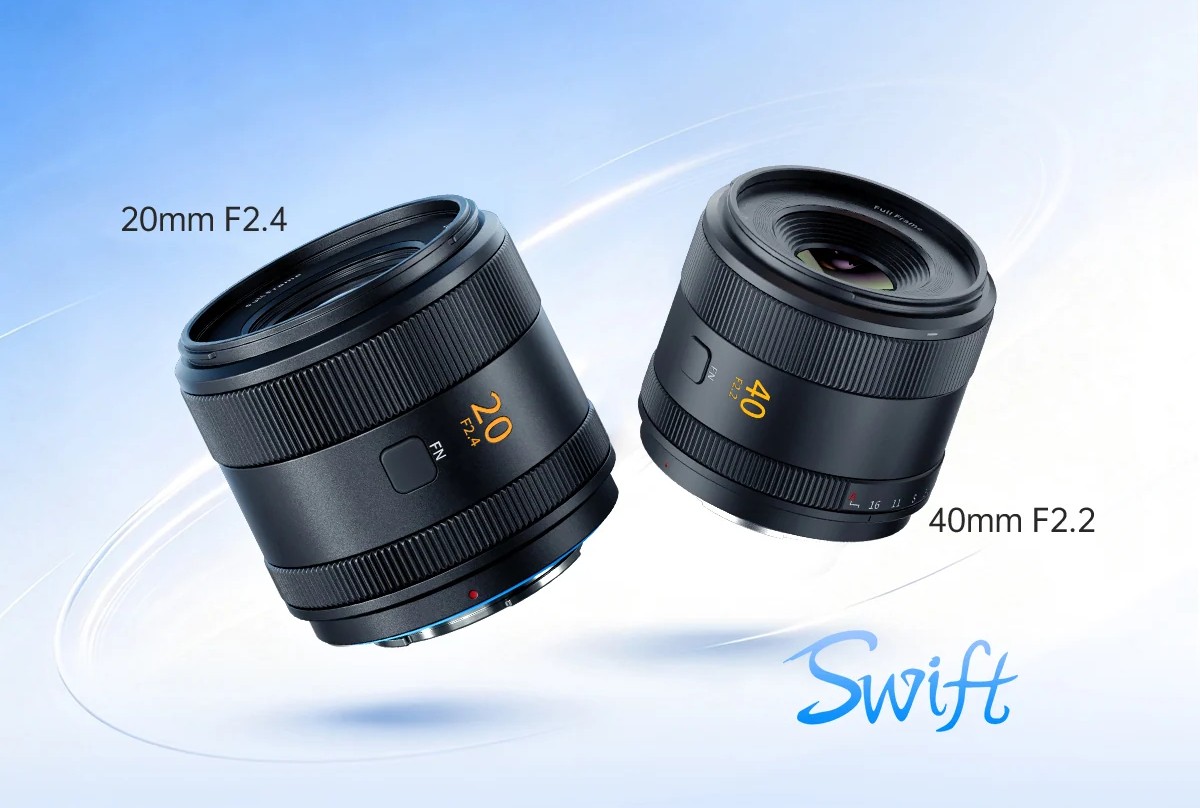
DAMAKORONKOWA - The optics market has been shaken by the introduction of two remarkably affordable prime lenses from renowned manufacturer SIRUI. Redefining what budget-friendly gear can achieve, the company has released the Swift AF 20mm f/2.4 and the Swift AF 40mm f/2.2. These lenses break new ground by offering advanced features like physical aperture rings, integrated weather sealing, and specialized Extra-Low Dispersion (ED) glass elements—all for an astonishingly low price of $149 each. To put this into perspective, even the nearest budget competitors lack this robust combination of professional specifications.
While comprehensive, independent optical bench testing is still pending for both models, their impressive spec sheets have instantly caught the attention of photographers shooting with Sony E-mount, Fujifilm X-mount, and Leica L-mount systems. Creators looking to maximize a modest budget while exploring full-frame autofocus photography finally have compelling new options to consider.
Inside the SIRUI Swift Series: What $149 Buys
Both lenses boast a core feature set that would have been virtually unheard of at this price point until recently.
-
Swift AF 20mm f/2.4 Specifications:
- Optical Construction: 11 elements arranged in 9 groups, featuring 2 ED elements, 2 aspherical elements, and High Refractive Index (HRI) elements.
- Physical Dimensions: Weighs just 207 grams (7.3 ounces) and measures 60.3 mm (2.37 inches) in length.
- Handling & Usability: Utilizes a 58 mm filter thread, a 9-blade aperture diaphragm for smooth bokeh, a dedicated aperture ring, a physical AF/MF switch, and a programmable function (Fn) button.
- Performance: Driven by a Stepping Motor (STM) for autofocus, offers a minimum focus distance of 0.24 meters (9.4 inches) with a maximum magnification of 1:7.3, and includes a USB-C port for firmware updates alongside manufacturer-claimed weather sealing.
-
Swift AF 40mm f/2.2 Specifications:
- Optical Construction: 11 elements in 8 groups, incorporating 2 ED elements and 1 aspherical element.
- Physical Dimensions & Controls: Shares the robust control layout of its sibling, featuring an aperture ring, AF/MF switch, programmable Fn button, and a 9-blade diaphragm.
- System Integration: Powered by an STM autofocus motor, equipped with a USB-C firmware port, and built with manufacturer-claimed weather sealing.
Both lenses are engineered to support Sony E-mount, Fujifilm X-mount, and Leica L-mount cameras. They made their debut on Amazon and the official SIRUI website, with preorders opening late in the year and initial shipments rolling out shortly thereafter.
The Optical Engineering Behind the $149 Price Point
Achieving a $149 price tag for full-frame prime lenses—especially when alternatives from brands like Tamron and Sony often range from $299 to well over $900—requires a close look at the underlying manufacturing and optical engineering choices.
Tackling Chromatic Aberration with ED Glass
When white light passes through a standard lens, it splits into its component wavelengths at slightly different angles. This phenomenon, known as chromatic aberration, typically creates unwanted color fringing along high-contrast edges in photographs.
Traditionally, lens designers use an achromatic doublet—pairing crown and flint glass elements—to bring two wavelengths to the same focal point. However, this often leaves behind a secondary spectrum where a third wavelength focuses differently.
Extra-Low Dispersion (ED) glass, characterized by an Abbe number generally exceeding 70, successfully corrects this secondary spectrum. When integrated with standard glass elements, all three primary wavelengths converge at virtually the same point, effectively eliminating color fringing.
SIRUI utilizes two ED elements in each Swift lens. According to the company, this is made possible by manufacturing its own ED glass at a dedicated facility in Zhongshan, Guangdong. By practicing this level of vertical integration, SIRUI bypasses the typical procurement markups associated with sourcing optical glass from traditional suppliers like Ohara or Schott, passing the savings directly to the consumer. However, this production model remains to be independently audited.
Controlling Spherical Aberration with Aspherical Elements
Standard spherical lens surfaces focus light near the optical axis accurately, but light passing through the outer edges of the glass often converges at a slightly different focal plane. This optical defect is called spherical aberration.
At wider apertures, such as the f/2.4 maximum on the Swift 20mm, this aberration can noticeably reduce center sharpness unless the lens is stopped down significantly. By incorporating aspherical elements—whose curves change continuously from the center to the edge—designers can correct this issue directly. The Swift AF 20mm utilizes two aspherical elements, while the 40mm incorporates one, though these design claims await formal optical bench verification.
High Refractive Index Glass for Compact Design
To keep the lenses pocket-friendly and lightweight, SIRUI implemented High Refractive Index (HRI) glass. This specialized material bends light much more sharply relative to its thickness, allowing engineers to use thinner and lighter glass elements without sacrificing optical performance. This innovation is the primary reason the Swift AF 20mm maintains a compact length of just 60.3 mm and weighs a mere 207 grams, perfectly aligning with its designation as an ideal daily carry lens.
Quiet and Efficient Autofocus Performance
For creators transitioning between still photography and videography, autofocus noise and smoothness are paramount. The inclusion of a stepping motor (STM) allows the lens to divide full rotations into highly precise angular steps, triggered directly by digital pulses from the camera body's AF processor for fast, nearly silent operation.
Because every individual step in the mechanism is both small and discrete, the stepping motor can effortlessly advance or reverse without producing any mechanical clunking or vibrations that might be picked up by an internal microphone. This particular characteristic makes stepping motor autofocus exceptionally well-suited for video recording environments, where the distracting operational noise typically generated by traditional coreless direct current motors would easily be captured by a camera's built-in audio recording equipment.
However, the primary tradeoff for this quiet operation is speed. The maximum pulse frequency inherent to stepping motor technology fundamentally limits how quickly the internal focus group can traverse its entire focal range. For fast-paced applications such as sports, intense action sequences, or wildlife photography—where subjects frequently move rapidly toward or away from the camera—stepping motor-based autofocus systems can occasionally hunt for focus or experience noticeable lag.
Neither of the lenses belonging to the Swift series makes any grand claims regarding exceptional autofocus tracking performance. Furthermore, the "Daily Carry" moniker clearly indicates that these products are purposefully designed for street photography, travel documentation, and casual hybrid-shooting scenarios rather than demanding sports or photojournalism environments.
How the Swift Primes Compare to the Competition
The most direct and prominent competing option for the 20mm focal length category is the Viltrox AF 20mm f/2.8, which has historically served as the benchmark for budget-friendly, full-frame prime lenses on the Sony E-mount system. A direct comparison of specifications provides valuable context:
- SIRUI Swift AF 20mm f/2.4: Priced at $149, featuring claimed weather sealing, a dedicated aperture ring, an f/2.4 maximum aperture, and a lightweight build of 207 grams (7.3 ounces).
- Viltrox AF 20mm f/2.8: Priced at $176, lacking weather sealing and an aperture ring, featuring an f/2.8 maximum aperture, and weighing 157 grams (5.5 ounces).
- Tamron 20mm F2.8 Di III OSD: Priced at $299, featuring weather sealing but no aperture ring, an f/2.8 maximum aperture, and a weight of 220 grams (7.8 ounces).
- Panasonic Lumix S 20mm F2.5: Priced around $500, featuring weather sealing without an aperture ring, an f/2.5 maximum aperture, and a featherlight weight of 142 grams (5.0 ounces).
- Sigma 20mm f/2 DG DN: Priced at $699, equipped with weather sealing and an aperture ring, featuring an f/2 maximum aperture, and a heavier build of 370 grams (13.1 ounces).
- Sony FE 20mm F1.8 G: Priced at $998, featuring comprehensive weather sealing and an aperture ring, a bright f/1.8 maximum aperture, and weighing 373 grams (13.2 ounces).
The compiled data clearly demonstrates that the SIRUI Swift 20mm occupies a unique market position that previously did not exist: it comes in at a lower price point than the competing Viltrox model while simultaneously offering built-in weather sealing and a physical aperture ring. While the Viltrox alternative is slightly lighter and features a half-stop slower maximum aperture, whether SIRUI's optical quality can truly match Viltrox remains an open question until comprehensive, independent testing is officially published. Meanwhile, for the 40mm focal length, there are virtually no direct budget-tier, full-frame autofocus prime competitors available on Fujifilm X-mount or Leica L-mount systems at a comparable price point, making the Swift AF 40mm f/2.2 a remarkably singular option for photographers shooting within those ecosystems.
What SIRUI's Chinese Roots Mean for Buyers
SIRUI operates under Guangdong SIRUI Optical Co., Ltd., a publicly traded enterprise originally founded in 2001 with its corporate headquarters located in Zhongshan, Guangdong Province, China. The company successfully listed on China's National Equities Exchange and Quotations system in late 2022. North American market distribution is managed through Sirui USA LLC, a registered subsidiary based in New Jersey that oversees all warranty services and customer support inquiries for buyers located in the United States, backed by a comprehensive three-year manufacturer warranty.
As a registered Chinese business entity, SIRUI is legally subject to the regulatory framework of China's National Intelligence Law of 2017. Specifically, Article 7 of this legislation dictates that all organizations and local citizens must support, assist, and cooperate with national intelligence operations in accordance with the law. This statutory obligation applies directly to SIRUI as a corporate entity; therefore, if Chinese intelligence authorities were to formally demand the company's business records, proprietary manufacturing specifications, or customer data, the organization would be legally mandated to comply. A similar regulatory framework is reinforced by both the Data Security Law of 2021 and the Cybersecurity Law of 2017, which collectively dictate how domestic companies must manage data transfers originating outside of China's borders.
However, understanding what this means specifically for photographic lens buyers requires looking closely at the hardware itself:
- Camera lenses are fundamentally passive optical instruments. The SIRUI Swift lenses contain absolutely no internal processor, no wireless radio transmitter, no data storage capacity, and no network interface of any kind.
- Because of this physical simplicity, these lenses are completely incapable of collecting, transmitting, or storing any form of user data. Photographers utilizing these lenses are not inadvertently feeding personal information back to SIRUI or to any government entity through the physical lens hardware.
- The statutory obligations outlined within the National Intelligence Law apply strictly to SIRUI as a corporate business entity—they have no bearing on the inert glass and precision metal housed safely inside the lens barrel.
There are two primary dimensions regarding performance and verification that potential buyers should carefully consider before purchasing hardware from an international manufacturer:
- Performance gaps versus Japanese-brand competition: Real-world autofocus speed and tracking accuracy on the Swift lenses have not yet been measured by independent testers. SIRUI's previous generation of mirrorless lenses—including the popular Anamorphic series and the Sniper AF series—received notably mixed reviews regarding autofocus consistency, particularly when mounted on non-Sony camera bodies, with some users highlighting camera-dependent behaviors. Whether the newer Swift series successfully rectifies these past inconsistencies remains entirely unverified.
- Benchmark reliability and independent verification: Every technical optical specification provided by the manufacturer—including the exact count of Extra-Low Dispersion elements, aspherical element quantities, total weight measurements, and weather-sealing claims—originates directly from SIRUI marketing materials. To date, no rigorous optical bench data has been published by recognized independent testing laboratories. Consequently, all of SIRUI's optical specifications should be treated strictly as manufacturer claims pending thorough, independent review.
Ecosystem Maturity and Operational Support
When evaluating third-party lens manufacturers, the surrounding support infrastructure plays a critical role in the long-term ownership experience. SIRUI USA provides dedicated warranty service based in the United States, yet their domestic repair and support network is relatively young. Compared to industry mainstays like Tamron and Sigma—both of which have operated established US-based service centers for decades—SIRUI is still building out its operational footprint.
However, a major technological differentiator for SIRUI is its implementation of USB-C firmware update ports directly on the lenses. This feature allows the company to push autofocus algorithm enhancements and performance patches long after a product has hit retail shelves. For early adopters of previous SIRUI autofocus lens lineups, this capability proved highly beneficial, yielding noticeable performance upgrades months after the initial product launch.
Regulatory Considerations and Corporate Compliance
Corporate governance and regional legal obligations also factor into purchasing decisions for some consumers. As noted previously, compliance with regulations such as the National Intelligence Law applies to SIRUI as a corporate entity, though the physical camera lenses themselves introduce zero data security risks. Photographers and videographers who maintain strict professional or security protocols regarding equipment sourced from China-headquartered suppliers must weigh these corporate factors against the compelling performance, aggressive pricing, and feature sets offered by the brand.
What the Spec Sheet Cannot Confirm Yet
Despite the excitement surrounding these announcements, the most crucial variable regarding both Swift lenses remains completely unconfirmed by marketing materials: actual optical performance.
- Weather Sealing Claims
- The weather sealing advertised for the Swift lenses represents a manufacturer self-declaration.
- Unlike consumer electronics that undergo strict certification processes like IEC 60529 (the standard behind official IP ratings), photographic lenses from almost every major manufacturer—including higher-priced offerings from Tamron and Sigma—rely on proprietary terminology like "weather-resistant" or "weather-sealed" without independent laboratory certification.
- Consequently, SIRUI's claims regarding the Swift series carry the same uncertainty found in any unreviewed product launch. True field durability will only become clear once working units spend extensive time in the hands of creators facing harsh weather conditions.
Similarly, resolving power, chromatic aberration control, geometric distortion, and peripheral vignetting across various f-stops cannot be verified until independent optical bench tests are published. These comprehensive reviews typically arrive within six to ten weeks after a lens reaches testing labs. Sony E-mount variants generally attract early review attention due to the massive size of the Sony Alpha user community, whereas Fujifilm X-mount and Leica L-mount versions may take slightly longer to appear in published media.
For buyers forced to make purchasing decisions before reviews emerge, the combination of features packed into the SIRUI Swift at the $149 price point lacks any direct market equivalent. The ultimate determining factor remains whether SIRUI's promised optical quality holds up under rigorous, independent examination.
Where to Buy and Expected Delivery Timelines
Shooters interested in acquiring the new glass will find that both the Swift AF 20mm f/2.4 and the Swift AF 40mm f/2.2 are available for purchase directly through Amazon and the official SIRUI website. The lenses launch with options for Sony E-mount, Fujifilm X-mount, and Leica L-mount platforms, each priced at an identical $149. SIRUI has indicated that initial units are scheduled to begin shipping near the end of the week of November 7, 2026. Meanwhile, international pricing structures and broader retail availability through European and Asian distributors remain unconfirmed by independent channels.
Frequently Asked Questions
Is SIRUI a reputable camera lens brand?
SIRUI (Guangdong SIRUI Optical Co., Ltd.) was established in 2001, building a two-decade track record manufacturing professional tripods, camera support accessories, and specialized lenses. The enterprise is officially listed on China's National Equities Exchange and Quotations (NEEQ). Previous autofocus entries, such as the Sniper AF series, garnered generally favorable reviews for optical clarity, though autofocus speed and tracking consistency occasionally varied depending on the specific camera mount used. Because the Swift series introduces SIRUI's very first weather-sealed, full-frame autofocus prime lineup, a historical track record specifically for this product tier is still being established.
How does the SIRUI Swift compare to the Viltrox AF 20mm f/2.8?
The Viltrox AF 20mm f/2.8 retails for $176 and is restricted exclusively to the Sony E-mount ecosystem. It is slightly lighter—weighing 157 grams (5.5 ounces) compared to the SIRUI's 207 grams (7.3 ounces)—while featuring a half-stop slower maximum aperture of f/2.8 versus the SIRUI's f/2.4. Crucially, the Viltrox alternative lacks both physical weather sealing and a dedicated manual aperture ring. By undercutting the competition by $27 while adding a faster aperture, weather protection, an aperture ring, and native mounting options for Fujifilm X and Leica L systems alongside Sony E, the SIRUI Swift AF 20mm f/2.4 presents an aggressive value proposition. The primary remaining caveat is optical performance, as Viltrox maintains an established portfolio of independent reviews while the SIRUI Swift is still brand new.
What does "weather sealed" mean on the SIRUI Swift lenses, and how reliable is that claim?
When SIRUI labels the Swift lenses as weather-sealed, it indicates that internal designs incorporate rubber gaskets and protective seals around the lens mount and moving mechanical joints to help repel dust and minor moisture droplets. Nevertheless, the term "weather sealed" within the photography industry is not governed by a standardized, universally certified rating system; rather, it is a manufacturer-driven declaration. No third-party ingress protection certification (such as IP67 or IP68 standards under IEC 60529) has been independently awarded to these lenses. Practically speaking, weather resistance on brand-new lenses from any manufacturer should be viewed as an added layer of security for shooting in gentle drizzle or dusty environments rather than an absolute waterproof guarantee.
Independent durability testing for the SIRUI Swift lenses has not been published as of this writing. This leaves many prospective buyers wondering whether they should take the plunge now or exercise patience.
Should You Buy the SIRUI Swift Now or Wait?
To make the best decision for your specific photography and videography needs, it helps to weigh the pros and cons based on your current gear lineup and shooting style. Here is a breakdown to help guide your purchasing decision:
-
For Sony E-Mount Enthusiasts on a Budget
If you shoot primarily with a Sony E-mount camera and focus your efforts on street photography, travel documentation, or casual video creation—and you do not rely heavily on lightning-fast subject-tracking autofocus—the $149 price point is an extraordinarily compelling value proposition. With built-in weather sealing and a dedicated physical aperture ring, it offers a feature set that has virtually no direct equivalent at this price point on the current market.
-
For Professionals and Critical Quality Seekers
If your workflow demands guaranteed optical sharpness, flawless autofocus accuracy under pressure, or heavy-duty performance in extreme weather conditions where reliable weather sealing is non-negotiable, a more cautious approach is warranted. Waiting for independent optical bench data and comprehensive field reports—which are typically published within six to ten weeks of initial shipping—will give you a clearer picture of long-term reliability.
The Role of Firmware Updates
One important technical consideration that sets modern budget lenses apart from older legacy glass is the inclusion of a USB-C port for firmware updates. This means that autofocus performance and overall lens optimization have the potential to improve significantly even after the product has officially launched.
This upgrade capability is a crucial factor worth weighing, especially if early adopter reviews happen to identify minor autofocus limitations out of the box. Knowing that the manufacturer can patch and refine performance over time softens the risk of buying into a first-generation lens ecosystem.


Post a Comment for "SIRUI Swift Lenses: Weather-Sealed Autofocus for $149 Shakes Up the Market"